The operational reality of managing data collectors, appraiser handoffs, and compliance documentation in a bifurcated valuation world
The traditional appraisal process had one workflow. An order comes in; an appraiser is assigned; the appraiser visits the property, conducts the analysis, writes the report, and delivers it. The AMC’s back office was designed around that single thread for one vendor, one assignment, one delivery, and one QC review.
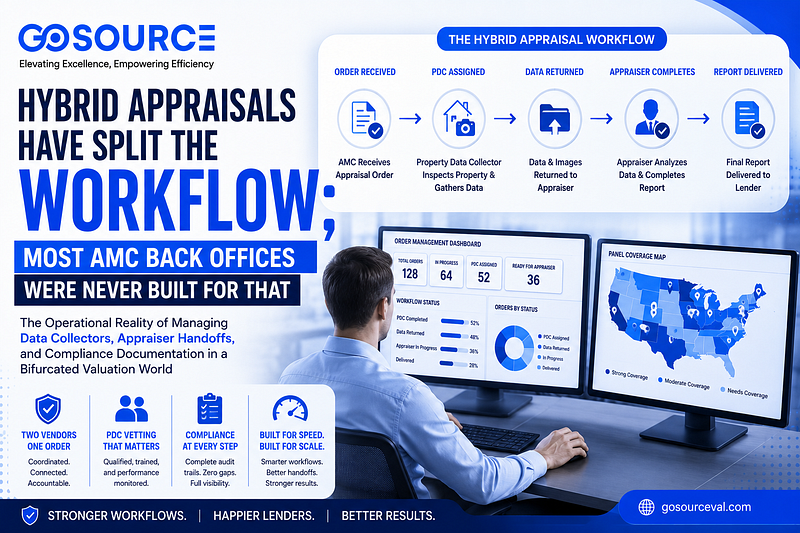
Hybrid appraisals are now the industry’s preferred term for what was previously called bifurcated appraisals, break that into two separate workflows that must be coordinated, tracked, and quality-controlled independently before they can be reconciled into a single deliverable. An appraisal order is assigned to an appraiser, and once accepted, the same order is then assigned to a Property Data Collector (PDC). The PDC goes onsite and walks through the property to gather data and images. Once complete, the data and images are returned to the appraiser, who then completes their report.
That sounds operationally straightforward. In practice, it creates a set of back-office coordination challenges that most AMCs significantly underestimated when hybrid volume started growing — and that are now separating the operations built for this model from the ones still improvising around it.
Two Vendor Relationships, One Order, Zero Margin for Coordination Failure
The fundamental operational shift in hybrid appraisals is that an AMC is now managing two independent vendors for a single order: a Property Data Collector for the inspection and a licensed appraiser for the analysis. These two parties often have no direct relationship with each other, work on different timelines, and have different performance tracking requirements.
If the PDC delivers incomplete photo coverage, the appraiser cannot complete the report. If the appraiser is not available to receive the data package when the PDC delivers it, the order sits. If either party has a credential or scheduling issue, the entire order is affected, but the failure may not be visible to an AMC coordinator managing the order through a system that was designed for single-vendor assignments.
Manual processes and fragmented systems in AMC operations often lead to delays, errors, and strained communication with appraisers, and hybrid appraisals amplify every one of those failure modes because there are now twice as many handoff points where something can go wrong.
AMCs that are winning on hybrid volume have redesigned their order management workflows specifically for the two-vendor model: separate assignment queues for PDCs and appraisers, automated status tracking at each handoff point, and escalation logic that flags coordination failures before they impact delivery timelines.
The PDC Vetting Problem Nobody Planned For
When the hybrid appraisal model first expanded, the operational conversation was almost entirely about appraiser assignment and report quality. What received far less attention was the back-office infrastructure needed to properly vet, credential, and manage a separate population of Property Data Collectors who are subject to different licensing requirements than appraisers, vary significantly in quality, and in some states face specific regulatory requirements.
Because managing the bifurcated process can be cumbersome, most lenders work with AMCs that are fully prepared to handle hybrid appraisals end-to-end. “Fully prepared” means more than just having a PDC network. It means having vetting standards for data collectors, documented training requirements, geographic coverage across your lender markets, and performance tracking that is separate from your appraiser panel metrics.
AMCs that are treating PDC management as an extension of their existing appraiser panel processes are running into problems. The two populations require different credential tracking, different performance metrics, and different escalation procedures when quality issues arise. The AMC back offices handling hybrid volume well have essentially built two parallel vendor management systems that feed into a unified order management workflow.
Compliance Documentation Has Doubled in Complexity
The AIR compliance requirements for appraisal orders do not simplify when the workflow splits; they multiply. An AMC managing a hybrid order now needs to document the separation of production staff from both the PDC assignment and the appraiser assignment, maintain audit trails for two separate vendor communications, and ensure that the data package handoff between the PDC and the appraiser is documented in a way that satisfies regulatory examination requirements.
Every assignment decision must be logged with reasoning, and all communications between lenders, AMCs, and appraisers must be captured with timestamps creating an unbroken chain of custody that satisfies regulatory examination requirements. In a hybrid workflow, that chain of custody now has an additional link: the PDC engagement, inspection completion, and data delivery all need to be part of the documented record.
AMCs that do not have systematic documentation workflows for both legs of the hybrid order are creating compliance exposure that will show up during lender audits and increasingly during regulatory examinations as hybrid volume becomes a larger share of overall appraisal activity.
UAD 3.6 Is About to Make This More Important, Not Less
The UAD 3.6 transition, with full adoption mandated by November 2026, adds another layer of operational complexity to hybrid appraisal management. Under UAD 3.6, the property data collected by the PDC needs to be fed into a structured digital dataset that the appraiser then uses as the basis for the report. That integration between data collection and report generation requires back-office systems that can handle structured data inputs, not just photo packages and PDF inspection reports.
UAD 3.6 paves the way for broader integration of AI and automation into daily appraisal workflows, with automation and AI assisting in data verification and quality control allowing appraisers to focus on analysis and professional judgment. For AMCs managing hybrid orders, this means the PDC data package will eventually need to be structured in a format that integrates directly with the appraiser’s digital reporting workflow. The AMCs investing in that infrastructure now are building toward a compliance requirement, not just an operational nicety.
What the Back-Office Rebuild Actually Requires
For AMC operators assessing where they stand on hybrid readiness, the honest evaluation comes down to a few specific questions. Do you have a separate PDC management workflow, or are data collectors being managed through the same processes as your appraiser panel? Do your order management systems track both vendor assignments independently and flag coordination failures automatically? Does your compliance documentation cover both legs of the hybrid order with the same rigor as a traditional appraisal?
For AMCs that built their back-office operations around the traditional single-vendor model, answering those questions honestly usually reveals meaningful gaps. The good news is that these are operational problems with clear solutions to process redesign, system configuration, and staffing adjustments that do not require starting from scratch.
This is exactly where specialized AMC management solutions deliver the most value: building the back-office infrastructure for hybrid order management, PDC panel governance, and dual-compliance documentation without requiring an AMC to figure out the architecture from the ground up while also running its existing volume.
The Bottom Line
The hybrid appraisal model is not a future trend for AMC operations; it is a present operational reality that is only going to grow as GSE acceptance expands, and lenders look for faster, more efficient valuation products. The AMCs that treat it as a workflow variation of the traditional model are going to keep running into coordination failures, compliance gaps, and lender complaints that they cannot easily trace back to a root cause. The ones that rebuilt their back-office operations specifically for the two-vendor workflow are the ones that can scale hybrid volume without the friction. In 2026, that distinction is starting to show up in lender preferences.
FAQ
What is a hybrid appraisal, and how does it differ from a traditional appraisal?
A hybrid appraisal, previously called a bifurcated appraisal, splits the work between two separate parties: a property data collector who completes the physical inspection and a licensed appraiser who performs the analysis and writes the report from their desk. A traditional appraisal has the same appraiser to handle both the inspection and the analysis.
Why do hybrid appraisals create back-office challenges for AMCs?
Hybrid appraisals require AMCs to manage two separate vendor relationships for a single order, coordinating the PDC inspection, the data handoff to the appraiser, and the final report of delivery. Each handoff point is an opportunity for coordination failure, and compliance documentation requirements apply to both legs of the workflow.
How should AMCs manage property data collectors differently from appraisers?
PDCs require separate vetting standards, different credential tracking requirements, different performance metrics, and, in some states, specific licensing compliance. AMCs that manage PDCs through the same processes as their appraiser panels often find that quality control and geographic coverage gaps go undetected until they show up as order problems.
What does UAD 3.6 mean for hybrid appraisal operations?
UAD 3.6 creates structured digital data requirements that will eventually integrate the PDC data collection phase directly with the appraiser’s digital reporting workflow. AMCs with hybrid back-office infrastructure built for structured data inputs will be better positioned for the UAD 3.6 transition than those still managing PDC deliverables as unstructured photo packages.
How can outsourced AMC management solutions help with hybrid appraisal operations? Outsourced AMC management partners can provide the process architecture, staffing, and documentation workflows needed to run hybrid appraisal operations correctly, covering PDC panel management, dual-vendor order tracking, and compliance documentation without requiring an AMC to rebuild its internal operations while simultaneously managing existing volume.